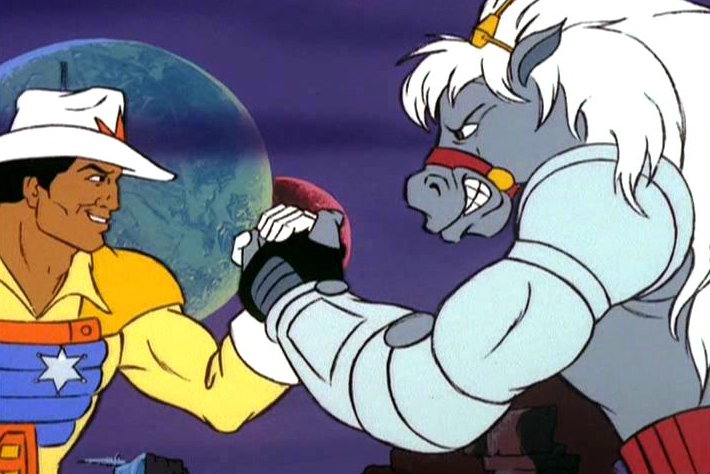
What do you get when you have a riot, a marshal, and an Equestroid? One heck of a show!
------------------------------
1.HISTORY
------------------------------
1.HISTORY
How late I discovered Bravestarr and once I did, I couldn't get the theme song out of my head. I found out about this show through YouTube long ago. I don't really remember which episode was my first viewing of the show (it might have been the movie), but I started watching it and I really dug the western-space vibe to it.
The adventures, the action and the '80s-ness of it all were all entertaining, but what really made me become a fan of Thirty-Thirty and the show by extension was a music video focused on the super stallion. Unfortunately, the video is no longer available for viewing, but I remember it was an AMV set to the song, 'Spoilin' for a Fight' by AC/DC. It was about three or so minutes of Bravestarr footage with the song playing over various scenes, but a majority of the footage focused on the first rocky encounter between Thirty and Bravestarr, where they fight it out at the Hall of the Equestroids in the film. I was blown away by how well the song seemed to match the energy of the scene, and how it captured Thirty-Thirty's larger than life essence and his love for fighting. A few more videos, mainly show commercials and bumpers, only sealed the deal.
------------------------------
2. THE (TECHNO) HORSE OF THE HOUR
One surprising aspect about this guy is his desire to get paid for his work. There were at least three instances where he called attention to it: "The Disappearance of Thirty-Thirty", "Sunrise, Sunset", and most notably, "A Day in the Life of a New Texas Judge". Not that I blame him; what he does can sometimes be grueling work and he wants compensation for it. I just find it an interesting and unexpected facet to him. I'll discuss a headcanon for why he points this out in the second part of this character analysis.
Thirty-Thirty doesn't like to be called just a mere horse for one thing. He'll assert he's a techno horse, and with his temperament and gadgets, he's proud of his heritage.
Around the time when the show aired, Thirty-Thirty was already standing out among Filmation audiences and still does today. He's more belligerent than other supporting Filmation characters like Orko or Kowl of He-Man and She-Ra respectively. And he's also very vocal - he doesn't beat around the bush when speaking his mind. If he has a complaint to voice, he will let you know about it. Sometimes his complaints are really minor where I can either roll my eyes or laugh it off. But he will also speak up when something is not right, although a bit harshly sometimes, which does serve as a strong counterbalance to his dissatisfied remarks.
When he's not shouting out his opinions, he's either happily fighting with his beloved and trusty weapon, Sara Jane, or putting his full strength to the test while he stomps the bad guys. Which is a good thing for the heroes, considering if you get kicked or stepped on by a horse, you're going to end up in the hospital, as the villains probably have done. So Thirty's a horse of action, and does not like to be tied down with tedious but important work, such as patrolling the perimeters around Fort Kerium.
Around the time when the show aired, Thirty-Thirty was already standing out among Filmation audiences and still does today. He's more belligerent than other supporting Filmation characters like Orko or Kowl of He-Man and She-Ra respectively. And he's also very vocal - he doesn't beat around the bush when speaking his mind. If he has a complaint to voice, he will let you know about it. Sometimes his complaints are really minor where I can either roll my eyes or laugh it off. But he will also speak up when something is not right, although a bit harshly sometimes, which does serve as a strong counterbalance to his dissatisfied remarks.
When he's not shouting out his opinions, he's either happily fighting with his beloved and trusty weapon, Sara Jane, or putting his full strength to the test while he stomps the bad guys. Which is a good thing for the heroes, considering if you get kicked or stepped on by a horse, you're going to end up in the hospital, as the villains probably have done. So Thirty's a horse of action, and does not like to be tied down with tedious but important work, such as patrolling the perimeters around Fort Kerium.
Patience is not an easy virtue for him to maintain whereas Bravestarr exhibits this virtue well. This is an important contrast to Bravestarr, actually; Thirty-Thirty's about the stompin', Bravestarr's about the thinkin', and why their dynamic - especially during their arguments - is partly compelling to watch, and adds another layer of depth to their relationship. They both have contrasting views, but they both value each other's sense of honor and fair play, which is a reason why their friendship still stands.
But even though he is strength-focused, Thirty-Thirty's not without his smart side and keen sense of awareness. In situations where action is not an option, he will adapt and use other methods, like in "Fallen Idol", where he called upon Deputy Fuzz to dig a tunnel so the two of them can stealthily trail after Bravestarr in case he needed help. In "Ship of No Return", he exercised caution when he, Bravestarr, Fuzz, J.B. and her father, entered the Kerium freighter and discovered no one was onboard, save the five of them. Shoot, even in "Big Thirty and Little Wimble", he held back his aggression because Wimble and the other children looked up to him. As an officer of the law, even if he's gung-ho most of the time, he is aware sometimes self-restraint or any other non-violent resource will prove the best solution, especially during really tense scenes (no matter how badly he just wants to shoot first and ask questions later).
If he finds that he did something wrong and it negatively impacted others, he will self-reflect on what he did and try to make amends for it. Hot-tempered he may be, but he's not close-minded to reason or emotion. He'll learn - sometimes the hard way - his lesson and admit his mistakes, as shown in "Rampage", "The Ballad of Sara Jane", and "Balance of Power" to name a few. In those episodes, he either let his temper and/or worry got the better of him or he acted carelessly in his responsibilities, but he accepts what happened and does learn valuable lessons even if he doesn't want to outright admit it. I mean, considering he, Bravestarr and other characters give PSAs at the end of each episode, I think it's safe to say he's taken those lessons to heart.
If he finds that he did something wrong and it negatively impacted others, he will self-reflect on what he did and try to make amends for it. Hot-tempered he may be, but he's not close-minded to reason or emotion. He'll learn - sometimes the hard way - his lesson and admit his mistakes, as shown in "Rampage", "The Ballad of Sara Jane", and "Balance of Power" to name a few. In those episodes, he either let his temper and/or worry got the better of him or he acted carelessly in his responsibilities, but he accepts what happened and does learn valuable lessons even if he doesn't want to outright admit it. I mean, considering he, Bravestarr and other characters give PSAs at the end of each episode, I think it's safe to say he's taken those lessons to heart.
When the situation calls for it, he can be gentle and tone down his gruffness. In the climax of the episode, "The Price", for instance, he acts as a calming presence around Jake's mother while she's grieving over the loss of her son. Thirty-Thirty doesn't say a word to her; he just stands there and holds onto her to show his support while she mourns Jake. In a more comedic moment, he admits he cries at weddings in "Memories" when Angus McBride and Karen Kane wed. It's a cute moment and shows Thirty's not all rough-and-tumble.
Loyal and honorable to a degree, Thirty-Thirty is a strong believer in earning friendship. To paraphrase him, he states, "you can't just snatch friends from off the streets; you gotta earn them". This is especially true given how he and Bravestarr met; the latter saved him before the Hall of the Equestroids collapsed on them, even after their rough scuffle over Sara Jane. That's bonafide proof, and it's enough for Thirty to extend his friendship to Bravestarr. Their friendship stands strong that when Thirty-Thirty thought his pard had been kidnapped in 'Rampage', he scoured across the worst parts of Fort Kerium and even stampeded his way to the Hexagon just to find his friend and make sure he's safe.
This protective streak towards his friends and his fellow citizens doesn't just come from his role as deputy, but also from his inherent horse instincts. Horses will protect their herds from danger; they'll constantly be on guard and act if something's threatening the group. This, along with the inclination to earning one's place in a herd, lines up with Thirty's protector role. All of this extends to his peers, not just because of his job, but also because of how he views his friends as his herd. We don't know what happened to the rest of his kind, so it would stand to reason Thirty-Thirty would seek out others to settle this instinct of his (even if he had to be dragged out of his home to see that). I don't know if that's what the people who worked on the show intended, but even if they didn't, it does add another layer of thought into his character.
This protective streak towards his friends and his fellow citizens doesn't just come from his role as deputy, but also from his inherent horse instincts. Horses will protect their herds from danger; they'll constantly be on guard and act if something's threatening the group. This, along with the inclination to earning one's place in a herd, lines up with Thirty's protector role. All of this extends to his peers, not just because of his job, but also because of how he views his friends as his herd. We don't know what happened to the rest of his kind, so it would stand to reason Thirty-Thirty would seek out others to settle this instinct of his (even if he had to be dragged out of his home to see that). I don't know if that's what the people who worked on the show intended, but even if they didn't, it does add another layer of thought into his character.
One surprising aspect about this guy is his desire to get paid for his work. There were at least three instances where he called attention to it: "The Disappearance of Thirty-Thirty", "Sunrise, Sunset", and most notably, "A Day in the Life of a New Texas Judge". Not that I blame him; what he does can sometimes be grueling work and he wants compensation for it. I just find it an interesting and unexpected facet to him. I'll discuss a headcanon for why he points this out in the second part of this character analysis.
Going back to "A Day in the Life of a New Texas Judge", we can also see he can be mischievous, as he teases his pard about forgetting to collect a parking fine from the character of the day. Poor Bravestarr has to pay the fine and Thirty-Thirty? He basically says, 'you're on your own, marshal, you pay for it'. Bravestarr gives his traitorous pard a disgruntled frown. Always makes me laugh!
He makes a lot dry and snarky jokes, sometimes with the intent to joke about how Bravestarr has a lot to learn from Thirty-Thirty, but he's never cruel about it. Joshing is how he lightens things up and shows his fun-loving and boisterous side. He's the kind of person with whom you would want to have a few pints of Sweetwater (if you can stand the stuff, but I'll just take a nice ginger beer, thanks lol.)
He makes a lot dry and snarky jokes, sometimes with the intent to joke about how Bravestarr has a lot to learn from Thirty-Thirty, but he's never cruel about it. Joshing is how he lightens things up and shows his fun-loving and boisterous side. He's the kind of person with whom you would want to have a few pints of Sweetwater (if you can stand the stuff, but I'll just take a nice ginger beer, thanks lol.)
Honestly, whenever Thirty-Thirty does things like this, it's a treat. It makes you want to get up and join in on the fun with him, and also learn a few good zingers in the process.
On a small note, I love how his voice actor, Mr. Ed Gilbert, gave him a verbal tic of making horse sounds as part of his way of talking. Sometimes there are moments where Thirty-Thirty will speak, but there's a brief husk of a whinny or nicker before he starts talking. Adds a nice touch to how he speaks. Also, Mr. Gilbert gave Thirty such a powerful and rocker-ish quality to his voice, one would wonder how he would fare in a 1980s metal band.
———————————————
3. DEPICTIONS/QUESTIONS
*"Is it awkward that Bravestarr rides Thirty-Thirty when he can stand on two legs? ": I personally would feel odd if I had a horse I could ride on who could also transform between quadruped and bipedal forms, and it is reasonable for non-New Texas citizens to be bewildered by Thirty's ability. But in a galaxy inhabited by humans, animals, aliens, robots and other creatures, this is probably nothing out of the ordinary. I take it as part of the natural law system of New Texas- they share similarities with intrinsic conventions of other worlds, yes, but they also don't conform to all of the laws of the universe we know. It's hinted in at least one episode that New Texas is not located within our solar system, so logically they would not be subjected to all of the same natural laws in our universe. Therefore, it may be illogical to the residents of one galaxy while it's completely normal by the citizens of New Texas.
*Thirty-Thirty or Thirty/Thirty? : It's a case of 'tomato, tomahto'. I go with the former spelling mainly to avoid confusion if I have to type it out in URL code.
More stuff to come in the next post!
More stuff to come in the next post!
Wanderer out!


